Improving Efficiency & Outcomes in the Federal Government
Contents
Section 2: Develop Policies Centrally
Section 3: Implement Best Practices Governmentwide
Section 4: Create Governmentwide Inspection Teams
Section 5: Introduce Performance Metrics Based on Outcomes
Section 6: Consolidate Support Functions for All Small Agencies
Section 7: Create a Governmentwide Suggestion Program
Section 8: Oversee and Publish Outcomes-Based Performance Metrics
Section 9: Consolidate Contracts and Blanket Purchase Agreements
Section 10: Limit Work Hours for Contractors
Section 11: Realign Oversight of the Inspector General's Offices
Section 12: Coordinate Activities Between Federal Agencies
Section 13: Create Full-Time Contract Selection Teams
Section 14: A Creative and Appealing Way to Save Taxpayers' Money
Section 15: Reduce the Number of Senior Executive Service (SES) Positions
Section 16: The Importance of Managers’ Initiative
Section 17: Introduce Comprehensive Manager Training
Section 18: Why These Changes Will Be Difficult to Implement
Section 1: Introduction
The June 2024 Pew Research Center survey shows that only 22 percent of respondents 'always or most of the time' trust the US federal government.[1] Similarly, a 2024 Partnership for Public Service poll shows that 85 percent of Americans believe the federal government is wasteful.[2] If a corporation had such low ratings, it would quickly go out of business.
This paper offers recommendations for establishing a problem-solving framework at all levels, developing innovative incentives, and providing imaginative solutions to longstanding issues. In addition to increasing trust, these recommendations will also significantly boost efficiency and outcomes while greatly reducing waste.
There are countless ways to improve efficiency and outcomes, and no department or agency should stop seeking improvements, even if they believe certain processes are already perfect.
Salvador Dali said it best. “Have no fear of perfection - you'll never reach it.”[3]
I asked six colleagues with federal government work experience to review this paper. Most said it makes sense, and they hope the recommendations get traction. One of my colleagues was shocked that I would recommend changing the government. To them it’s working beautifully. Clearly, 2.7 million federal government employees all have different work experiences. Whether or not we feel the government is working well or not, we should continually look for ways to improve its efficiency and outcomes. That’s the purpose of this paper. Here are a few quotes to put organizational change in perspective.
"Without continual growth and progress, such words as improvement, achievement and success have no meaning."[4] — Benjamin Franklin, American Founding Father and scientist
“Progress is impossible without change, and those who cannot change their minds cannot change anything.”[5] —George Bernard Shaw, Irish playwright and political activist
“Innovation is the ability to see change as an opportunity, not a threat."[6] — Steve Jobs, Cofounder of Apple Inc.
Section 2: Develop Policies Centrally
Why do all 400 federal government departments, agencies, and sub-agencies create their own policies on every subject? For most policy issues, there should be a single policy shared by all 400 government organizations.
Here's an example of why many federal government policies should be developed centrally rather than instructing each agency to create its own. On one occasion, every federal department and agency was instructed to draft a policy titled "Guidance on Domestic Violence, Sexual Assault, and Stalking in the Federal Workforce." All 400 departments and agencies made their own versions and submitted them to the Office of Personnel Management (OPM) for review. OPM reviewed each one and sent them back with suggestions. Why doesn't OPM produce a single policy for most policy topics that would apply across the federal government? OPM can distribute its draft to all agencies for review and input, just as the military services have successfully done for decades. In the case of the Domestic Violence policy, one small agency spent hundreds of hours developing and coordinating its version. Multiply that by 400, and creating one unified policy would be much more cost-effective than making 400 separate ones. It would also reduce confusion.
What could possibly be different about domestic violence, sexual assault, and stalking in different federal organizations?
With multiple versions of the same policy throughout the federal government, defense attorneys only need to point out that their client may have violated their agency’s policy, but it would not be considered a violation in many other agencies.
The US military services primarily develop and issue policies at the organizational level. This typically results in a single policy on most topics that applies within each branch of the military. This method greatly reduces costs and confusion. For example, suppose a major command within the Air Force—one level below Air Force headquarters—decides to change or modify an Air Force policy. In that case, it must submit its proposed changes to the department responsible for creating and issuing the policy at the Air Force level, along with an explanation of why an exception should be granted. Likewise, suppose an Air Force-level staff office wishes to create or significantly modify an existing Air Force-wide policy. In that case, it must submit a draft to the major commands for review and feedback before implementing the policy.
I recommend that OPM oversee the creation, coordination, review, and approval of all government policies. There are several key areas across all government departments and agencies where a single policy should exist for each subject. These include information technology, human resources, budgeting, procurement, finance, contracting, legal affairs, safety and security, and administrative services. Let's use this as a starting point for developing centralized policies.
Federal government organizations should follow the example of the military services by having a single policy that applies to all departments and agencies for each subject, whenever possible.
Section 3: Implement Best Practices Governmentwide
There are pockets of excellence within the federal government that often go unnoticed outside the organization where they reside. We must develop a framework and foster an environment that encourages innovative ideas to thrive and adopt these best practices across the entire government.
The Council of the Inspectors General on Integrity and Efficiency (CIGIE) should be expanded to review and ask all government organizations if each best practice will work in their organization. Based on this feedback, the CIGIE will determine if these best practices should be implemented governmentwide. Ensuring these best practices are adopted throughout the government will be the responsibility of the inspection teams mentioned in Section 4, "Create Governmentwide Inspection Teams." Of course, agencies can request a waiver from adopting any best practice by submitting their reasons to the CIGIE for review. The CIGIE will retain the final authority to approve or deny the waiver.
Here are a few examples of outstanding ideas that should become best practices across the government.
A senior official identified the need for formal manager training across his entire agency. When he couldn't find an appropriate course, he created and led his own "Effective Management" seminar, which consistently received high ratings. This training should be accessible to all agencies, and it should be mandatory for all new managers. Why are managers so important? Managers are the primary players in creating a positive and productive work environment. They drive 70 percent of their employees’ desire to do their best at all times.[1] The demand for manager training is worldwide, not just in the federal government. A 2020 Society for Human Resource Management study found that 84 percent of workers blame poorly trained managers for causing unnecessary stress and workload.[2] I’m sure that managers aren’t poorly trained; they aren’t trained at all. Please see Section 16: Introduce Comprehensive Manager Training for more information.
Why can’t the federal government lead the world in how to create better managers?
One agency revised its onboarding process. You only get one chance to make a good first impression — it's a cliché, but it's true. This agency carefully organized their employees’ first day to ensure they had a very positive experience. A Gallup survey shows that only 12 percent of respondents reported having a great onboarding experience,[3] while 80 percent of new hires with an unsatisfactory onboarding experience plan to quit.[4] Additionally, an astonishing 89 percent of new hires want to meet their bosses on their first day at work, and 83 percent want to meet their coworkers.[5] This is seldom done. These statistics indicate that private industry also needs to significantly improve its onboarding processes.
Here is an illustrative story that brings onboarding to life. I was hired by an internationally known and respected organization and arrived at HR on time for my onboarding. Each of us, as new employees, filled out a few forms to begin our pay and life insurance. The HR technician then gave each of us a six-inch-high stack of HR booklets and left the room. We all remained because we thought she would return and answer our questions. Eventually, one of the new employees tracked her down and asked if she was planning to return to answer questions. She looked surprised and said no.
Even leading organizations can become complacent.
Why can’t the federal government lead the world in showing how best to onboard employees?
One agency developed a fill-in-the-blanks form that helps departing staff share detailed job-related information with their successors. This reduces the 'ramp-up time' for new employees, enabling them to become fully productive much sooner. The form helps incoming staff quickly gain a comprehensive understanding of their job requirements from day one, including their role within the organization, working relationships, committee assignments, ongoing projects, deadlines, and other key details. How important is a quick start in a new job? An International Institute for Management Development survey finds that starting a new position is among the most challenging and stressful events in managers’ careers. How well they perform in the first few months often predicts their long-term success.[6] I have attached a fill-in-the-blanks form for job-related information. It’s found in the No-Nonsense Manager’s Playbook: A Guide for Leaders Who Need Answers Now![7]
These are examples of ideas that cost nothingand save taxpayers’ money. There are thousands of useful and cost-saving ideas buried throughout the federal government. We need a process to harness and distribute them.
Section 4: Create Governmentwide Inspection Teams
The United States Congress is the primary organization that oversees the departments and agencies of the US federal government. It conducts oversight through its committee system, which includes standing committees, select committees, and congressional support agencies. This oversight involves reviewing, monitoring, and supervising agency programs, activities, and policy enforcement, as well as authorizations, appropriations, and investigations. The Government Accountability Office (GAO), a legislative branch agency, also plays a key role in auditing and investigating federal spending. In addition, the Council of the Inspectors General on Integrity and Efficiency (CIGIE) is an independent entity within the Executive Branch, responsible for promoting professionalism and effectiveness within the IG community. CIGIE also addresses integrity and efficiency issues that affect multiple agencies.
I recommend that the CIGIE’s responsibilities be expanded to include establishing inspection teams to ensure all agencies implement best practices and outcome-based performance metrics promptly and accurately. Individual agencies should not be authorized to set their own performance metrics. For more details on performance metrics, see Section 5: Introduce Performance Metrics Based on Outcomes.
Inspections and inspection teams are not a new concept. General George Washington established the first Office of the Inspector General in 1777.[1] For almost 250 years, our military services have assigned inspection teams to ensure all departments operate efficiently. For example, the Air Force Inspection Agency (AFIA) conducts independent inspections of all Air Force units to enhance their peacetime and wartime missions. The AFIA regularly inspects all departments, including operational air squadrons, aircraft maintenance, hospitals, and more. After each inspection, inspectors prepare a report that highlights strengths, such as best practices, and identifies areas for improvement. These insights are quickly shared via secure video teleconferencing. The inspected units are then required to provide a written response for each deficiency, including a plan with milestones to address them. The inspection report is also distributed to all similar Air Force units, which are expected to implement the latest findings. The AFIA's inspection database, equipped with analytical tools, helps identify emerging issues and actionable information. These inspection teams are full-time. Because of the savings these experts generate, maintaining these teams would not be an additional cost to taxpayers overall but would actually save money.
All federal departments and agencies must be accountable for meeting their outcomes-based performance metrics. Only independent inspection teams can ensure this is done accurately and implemented promptly in all departments and agencies.
Section 5: Introduce Performance Metrics Based on Outcomes
The OMB is responsible for ensuring that all departments’ and agencies’ performance metrics are outcomes-based. These metrics allow the OMB to evaluate and improve the efficiency, effectiveness, and outcomes of all business processes. The Government Performance and Results Modernization Act (GPRMA) of 2010 requires each department and agency to create strategic plans that include their mission, goals, and objectives for at least four years, performance metrics, and reporting results. Two additional steps can ensure a better outcome. These can make the difference between success and failure.
When creating the most effective goals and objectives, managers must ensure that every employee understands their role in achieving them.
A Booz & Company online assessment of over 125,000 employees from 1,000 organizations in more than 50 countries shows that the top attribute of companies that successfully execute strategy is ensuring employees understand the actions and decisions that are theirs.[1] Effective managers ensure that all employees understand their work units’ objectives, how these objectives are linked to the organization’s strategic objectives, and their role in achieving them successfully.[2]
Measurable objectives must be created outside the organization.
I recommend that we require outcomes-based performance metrics be approved by the OMB, ensuring a single benchmark for each process that all agencies are expected to meet. If agencies are allowed to create their own metrics, they will likely set them too low. Currently, there is no penalty for setting the performance bar too low, which unintentionally encourages this behavior. This allows everyone to claim success by surpassing the (low) objectives.
Here is an illustrative story that highlights the importance of setting high standards for metrics. At one agency, a senior manager told her subordinate managers, ‘Here’s the way the game is played. When creating performance metrics, you set the bar low, and then when you exceed it, you get praised. If you set the bar too high and don’t achieve it, you never hear the end of it.” In this example, the senior manager achieved her goal — an easy target to meet. Did the taxpayers benefit from this approach?
How strategic planning works.
Strategic planning is a dynamic process that creates actionable and measurable objectives, showing how the organization plans to differentiate itself within its marketplace and create sustainable value.[3] Private industry has done strategic planning for over a century.[4] Unfortunately, studies show that they don’t do it very well. Strategy in corporate America gets far less attention than it should. Research reported in the Harvard Business Review reveals that 85 percent of senior managers dedicate under an hour to strategy each month, half spend no time at all, and only five percent of employees have a basic understanding of their organization’s strategy. Your employees are the people closest to your customers, and they know the least of anyone about your organization’s strategy. [5]
If strategy gets little attention in private industry, do you suppose that the federal government does better? Why can’t the federal government take the lead on strategic planning and show private industry how it’s done correctly?
On the next Federal Employee Viewpoint Survey, we must ask, “Are you familiar with the performance metrics for your organization and your role in achieving them?”
Managers' performance evaluations should include rating their success in achieving their objectives.
Developing performance metrics in the support side of departments and agencies
Let’s start by developing performance metrics for the support functions of each department and agency. These include information technology, human resources, budget, procurement, finance, contracting, legal, safety and security, and administrative services. Developing these metrics on the support side is easier than on the operational side because most business processes are consistent across all departments and agencies. Creating outcomes-based performance metrics for the operational side of all departments and agencies is more complex and will be addressed later in this section.
The OMB should assign functional area experts from various agencies to collaborate and develop outcome-based performance metrics, making sure they are reasonable and that the "bar" is set high enough. Once approved, all agencies must immediately adopt the performance metrics or provide an explanation to the OMB explaining why they should not be required to do so. The OMB will have the final authority to approve the performance metrics.
Here’s an exercise that will demonstrate the effectiveness of strategic planning within the federal government. OMB should pull the strategic plans from ten randomly selected agencies and compare their performance metrics for all support functions. They will show different metrics for the same areas even though there is only one best metric for each support area. OMB must oversee the process to create the most effective metrics.
Here is an example of a performance metric and how it was improved. The President’s Hiring Reform instructs federal agencies to hire staff within 80 days of validating the need, covering everything from recruitment and selection to the start of work. Only a few agencies meet the President's goal. Unfortunately, there is no governmentwide process to share the successful steps of agencies that achieve this. Why not? One small agency did meet this goal. For the curious reader, here's the key to shortening the hiring process. A senior manager created a 14-step hiring process.[6] Human resource staff tracked the time it took for each step. They quickly found that hiring officials were delaying the process. It was a considerable amount of work for them to review hundreds of applications, decide who to interview, conduct interviews, verify references, and make a final decision. The hiring officials delayed this work, missing the President's deadline. This not only delayed onboarding but also left work undone and hurt morale. What convinced them to stay on schedule was a reminder that the best candidates often accept offers elsewhere if they are delayed. Most job seekers apply to multiple jobs and accept the first good offer. Speed in hiring is crucial. A 2021 Society of Human Resource Management survey found that 96 percent of candidates accept their first offer.[7] The employer who makes the first offer gets the best candidates.
While we might applaud the few federal government agencies for hiring staff within the 80-day limit, private industry understands the importance of making the first job offer. A Glassdoor study in 25 countries shows that hiring takes an average of 23.7 days. The hiring time varies by job title; for example, systems engineers take longer than receptionists. If you have not selected a candidate by the average time it takes by job title, your top pick may be hired elsewhere. Here are some examples of the average number of days it takes to hire people for various job titles in the US: business systems analyst (45 days), software development engineer (41 days), finance manager (40 days), HR manager (32 days), receptionist (13 days), barista (10 days), machine operator (9 days) and waiter (8 days).[8]
The average age of a federal government employee is 47 years old. In 2023, the average age of a federal employee was 47.2. The average age of employees overall US is 41.7.[9] The federal government must work aggressively to attract younger workers.
Federal laws increase the time needed to hire and onboard new federal employees. The federal government is competing with private industry to attract the best talent. The OMB should collaborate with Congress to update existing laws, enabling the government to compete fairly with private industry in hiring top employees.
Developing performance metrics in the operational side of departments and agencies
Once we fully implement our outcomes-based performance metrics on the “support” side of each department and agency, we will then proceed to establish metrics in the remaining areas, which we will call the “operational” side. Developing outcomes-based performance metrics for the operational side is more challenging because each has distinct operational objectives.
The OMB must oversee the development of operational performance metrics for each department and agency based on outcomes. The OMB appoints experts in relevant areas to develop these metrics and ensure they are comprehensive, with the standards for each set being sufficiently high. In most cases, these experts work within different departments or agencies to maintain impartiality. The OMB may contract private industry experts to assist in developing these metrics. Departments and agencies are expected to adopt the performance metrics immediately or provide an explanation to the OMB if they believe the metrics do not apply to them. The OMB has the final authority to approve all performance metrics. The goal of the OMB is to elevate all departments and agencies, regardless of size or complexity, to the same high standard of excellence as quickly as possible.
Section 6: Consolidate Support Functions for All Small Agencies
I recommend that all small agencies, those with fewer than 1,000 employees, share support functions. These include information technology management, human resource management, budgeting, procurement, finance, contracting, legal, safety and security, and administrative services. Why should every small agency be fully staffed to handle all these support services at all times? These employees cannot possibly be kept busy full-time. US private industry should serve as our model. Most US companies have a single human resources (HR) office that provides all HR services in one location. Employees interact with them via phone and email. Why can’t small federal agencies do the same?
The OPM must oversee the consolidation of support functions for all small agencies.
The benefits of consolidating all support functions are shown through an example of the HR staffing and classification office.
Cost savings come from significantly reducing staff. Having enough staff at each agency to handle all types of work—from simple to complex—is inefficient. Staff cannot always be kept busy. Additionally, if the workload in one agency exceeds current staffing capacity, an extra position is created and a new staff member is hired. Was an additional full-time staff member necessary in every case? Most often, the answer is no. What is more likely needed is only a quarter or half of a full-time (FTE) position. According to current staffing guidelines, if at least 25 percent of the work is at the higher grade, the higher grade is assigned, and the staff increases by a full position. Unfortunately, with the addition of the new staff member, there are now more labor hours available than needed. These extra hours of this specialist’s time are usually filled with tasks requiring less skill or no additional work at all.
Significantly improved service quality. Currently, each agency must have enough human resource staff who are well-trained to handle all levels of staffing and classification, from simple to complex tasks. This means that in a small agency with only one staffing and classification technician, that technician must be fully prepared to manage even the most complicated assessments. Most of the time, they handle simpler assessments, which often leaves them underutilized. By consolidating all staffing and classification work in one central location, incoming workload can be triaged efficiently. The simplest tasks can be assigned to entry-level staffing and classification specialists, while more complex cases are referred to the most experienced staff. If an entry-level specialist has questions, senior experts are always available to help. Triaging incoming work enables more staff to focus on tasks that align with their training and experience. This workload triage method is used by private industry and has shown it to be a successful business model. Why doesn't the federal government adopt this approach?
Fully trained staff. A central staffing and classification office providing services to all small agencies can ensure that staff are fully trained.
Continuity of services is assured. Small agencies with just one or two staffing and classification specialists won't need to worry about how they will continue to deliver quality and timely work when a specialist leaves for another agency, retires, or takes a vacation.
Small agencies can concentrate on their missions and avoid wasting time on support function problems.
Managers will not be able to influence the grading of positions. Senior officials, including political appointees and career civil servants, will be unable to sway the grades of their subordinates. Promotions will only be granted if there is an increase in responsibilities that justifies a higher grade. Here is an example.
When an agency is about to lose a valued staff member to another agency, it sometimes "promotes" the incumbent to keep them from leaving. Did the staff member's duties change to justify the promotion, or was it done solely to retain the employee? Promoting valued staff simply to keep them without a corresponding increase in responsibilities is not legal. By centrally managing all staffing and classification actions, inappropriate promotions can be prevented. Promoting staff non-competitively violates Merit System Principles, Title 5 U.S.C. paragraph 2301 (b) (1), which states, "Recruitment should be from qualified individuals… solely based on relative ability, knowledge, and skills, after fair and open competition which assures that all receive equal opportunity."
Sadly, I have many examples of selfish and wasteful decisions by government managers who want to promote their favorite employees even if they are not qualified. Based on my experience, these outrageous actions occur frequently and result in significant costs to taxpayers. These “promotions” also hurt morale because other employees see these inappropriate promotions and wonder why they should work hard. The next Federal Employee Viewpoint should ask, “Are you aware of a promotion that you believe was not justified?”
In addition to ensuring that no one can influence the grade of subordinates, there are also instances where grade levels for the same work are different at various agencies. Here is an example. At one agency, the facility manager was in the pay grade of GS-14. Another agency hired this manager with the same level of responsibilities but at the GS-15 level. This would not happen if all position grading were done centrally.
All the savings outlined in the examples above are for just staffing and classification specialists in one small area of human resources. There are also significant savings available by consolidating all positions across small agencies in all support functions.
Section 7: Create a Governmentwide Suggestion Program
Each federal government department and agency has a suggestion program; however, no agency oversees these initiatives throughout the entire government. Therefore, there is no established process for evaluating a great idea from one agency to see if it can be implemented across the entire government.
The OPM oversees all departments’ and agencies’ suggestion programs. They can assess whether innovations and cost-saving ideas will work across the government. Employees, managers, auditors—both internal and external—and inspection teams should compete to save the most taxpayers' dollars by recommending the implementation of new ideas and best practices. The OPM should formally recognize those who introduce new ideas and best practices.
The OPM should establish proper monetary incentives to motivate new ideas and best practices. The reward for approved suggestions should not exceed two percent of the savings in the first year.
Credit should not be rewarded for ideas that already exist in one or more agencies.
Employees, managers, auditors (internal and external), and inspection teams should be encouraged to suggest ideas and offer improvements to outcomes-based performance metrics across the government. This can only be done centrally. The OPM is best positioned to ensure the success of this initiative.
Section 8: Oversee and Publish Outcomes-Based Performance Metrics
The OMB ensures that all departments and agencies meet their outcomes-based performance metrics and publish the results. American taxpayers want transparency about how well their agencies perform. OMB can formally recognize and reward agencies that exceed their metrics and deploy inspection teams and auditors to assist agencies that do not meet their goals.
Here’s an example that drives taxpayers crazy. Government overspending at the end of a fiscal year, sometimes driven by "use-it-or-lose-it" thinking, can lead to unnecessary purchases, inflated contracts, and hastened projects without proper oversight. The OMB must oversee late-year purchases. Additionally, why not acknowledge and thank departments and agencies that return unused funds? When departments and agencies return money, their budgets should not be reduced the following year by the amount they returned.
The Partnership for Public Service, a nonprofit, nonpartisan organization, annually recognizes various federal agencies as the Best Places to Work in the Federal Government. The ratings are based on the Federal Employee Viewpoint Survey (FEVS), which federal employees complete. Currently, there is no effort to determine what top-rated agencies are doing to achieve high scores. Can other agencies learn from them? Additionally, this survey does not ask employees about agencies’ efforts to improve outcomes or productivity.
Here’s an illustrative story that demonstrates the need to learn what top-rated agencies do better. In one organization, one office consistently received the highest FEVS score in its agency for six consecutive years. The director of this office was never asked how his office consistently achieved the top rating.
OMB must demonstrate to taxpayers how effectively our agencies are meeting their outcome-based performance metrics. Being a high-scoring office is very beneficial. More importantly, we need to prove to the American taxpayers that federal departments and agencies are successfully achieving their outcome-based performance goals.
Section 9: Consolidate Contracts and Blanket Purchase Agreements
Contracts and blanket purchase agreements should be consolidated as much as possible to lower overhead costs. The Defense Acquisition University defines a blanket purchase agreement (BPA) as “a simplified acquisition method that government agencies use to fill anticipated repetitive needs for supplies and services...One advantage of traditional BPAs is that a buyer can use them to acquire a comprehensive range of services under a single BPA, rather than having to purchase through multiple contracts. The BPA establishes a contractual relationship between the government and vendors who have been awarded a contract under the BPA.”[1]
Why should every small agency write identical contracts or BPAs to purchase the same goods and services? Even within the same agency, there are duplicative contracts that allow the purchase of identical goods and services.
Contracting officers should actively seek ways to decrease the number of contracts and BPAs. Fewer contracts result in fewer staff members and lower costs.
Contracts and BPAs are currently overseen by the Small Business Administration (SBA).
Existing contracts should be reviewed regularly to find those that can be consolidated.
Here is an illustrative story that brings the consolidation of contracts to life. At one agency, more than a dozen contracts providing administrative support to a single government department were combined into one contract offer. The bidders were encouraged to find ways to reduce staff and save money. The “best value” contract was awarded to a company that bid over 30 percent less than the total costs of the previous 12 contracts. The quality of the new single contractor was rated satisfactory for the base year and all four option years.
Worried that small and disadvantaged businesses might be excluded from this plan? Section 8(a) of the Small Business Act requires setting aside a portion of government contracts for these businesses. Federal contracting offices ensure that when contracts are combined, at least the minimum required portion of the work is awarded to small and disadvantaged businesses.
Why should every agency establish multiple contracts and BPAs to purchase the same items? Would a major US corporation permit each division to hold multiple contracts for the same common items, such as desktop computers and office supplies?
Section 10: Limit Work Hours for Contractors
The federal government must contractually limit the number of hours per week that government contractors can bill the government for each of their employees. Contractors must instruct each employee to certify whether they are doing any other paid work to ensure that no employee works more than 50 hours per week in total.
A 2013 Stanford University study shows that increases in output are relatively small as hours rise beyond 50 hours a week. There are no productivity increases in working more than 55 hours per week.[1] When contractors bill more than 50 hours per week, the federal government is paying for little to no increase in productivity.
A National Institute for Occupational Safety and Health review of multiple studies concludes that working overtime, more than nine hours per day, correlates with perceived poorer worker health and increased injury rates and illnesses. Employees feel less alert, have lower cognitive functioning, increased fatigue, increased injuries, and decreased vigilance.[2] For example, hospital nurses who work 10-hour shifts or longer experience higher levels of burnout and job dissatisfaction.[3]
How many hours does the average American work each week? According to a Gallup survey, the average American works 47 hours weekly. That is an average of 9.4 hours per day in a five-day workweek.[4]
Each government contract must have a statement requiring that no individual contractor will be paid for working more than 50 hours per week. Contractors must be required to provide the government the names, a unique identifier, and hours worked per week for their employees and sub-contractors. Contractors will forward this data the General Services Administration (GSA), who will compare all contracts to identify any contractors who are working more than 50 hours per week. Auditors will then have a method to regularly review this data to determine if any contract employees are working on more than one contract to determine if the employee is billing more than the maximum of 50 per week.
Yes, this is a problem but there are no studies to show how widespread it is. I have heard several contractors over the years bragging that they were billing the government 80 hours or more per week, often on more than one contract. Now that we know better, this must stop.
I recommend that the GSA work with Congress to write legislation to limit the number of hours per week that government contractors can bill the government for each of their employees.
Section 11: Realign Oversight of the Inspector General's Offices
Each federal department and agency has an Office of the Inspector General (IG), which is governed by the Inspector General Act of 1978. According to the Inspector General Act of 1978, as amended, the Inspector General's mission is to:
Conduct independent and objective audits, investigations, and inspections
Prevent and detect waste, fraud, and abuse
Promote economy, effectiveness, and efficiency
Review pending legislation and regulation
Keep the agency head and Congress fully and promptly informed.[1]
“The IGs serve under the general supervision of the agency head. Yet, by statute, IGs have a dual and independent reporting relationship to the agency head and Congress.”[2]
I recommend that all IGs report directly to Congress and the Council of the Inspectors General on Integrity and Efficiency (CIGIE), not the agency head. This will:
Ensure consistent oversight and accountability of all IGs;
Enable the CIGIE to coordinate the working relationship between the IGs and the inspection teams discussed in Section 4: Create Governmentwide Inspection Teams.
Removing the agency head from any supervisory responsibility will ensure the independence of the IG.
Each agency's top IG should only oversee a department or agency for no longer than four years before being reassigned. US DoD IGs serve for a 36-month tour. Regular rotation of senior IGs between agencies ensures that department and agency challenges are viewed with fresh perspectives. It also helps prevent IGs and the agency leadership from becoming too comfortable with each other.
I recommend that the CIGIE work with the Congress to amend the Inspector General Act of 1978 to reflect this.
Section 12: Coordinate Activities Between Federal Agencies
The OMB, specifically through its Office of Information and Regulatory Affairs (OIRA) is responsible for ensuring:
There are no instances where two or more departments and agencies share the same or similar responsibilities. OIRA can identify duplicate responsibilities when it oversees the development of outcomes-based performance metrics. Please see Section 5: Introduce Performance Metrics Based on Outcomes for more information.
All departments and large agencies should absorb smaller agencies and sub-agencies when they are compatible. Does the federal government really need 400 departments, agencies, and sub-agencies?
That federal agencies seek support from other agencies before contracting work outside the federal government.
All federal agencies must spend money only on activities authorized by law. Auditors can assist the OIRA in ensuring that funds are spent only on congressionally authorized expenses.
Our military services are responsible for ensuring that their mission does not gradually expand beyond their authorized scope. This is called “mission creep.” There are times when military services and federal agencies exceed their authorizations, which can lead to unnecessary expenses and unintended consequences.
For example, in 2001, the Department of Homeland Security was assigned the task of creating fusion centers as a counter-terrorism measure following the September 11 attacks. Fusion centers were designed to enhance information sharing regarding terrorism across different levels of government and private sector organizations. By 2011, there were 72 fusion centers in the United States. The role of these centers gradually expanded beyond monitoring terrorism to also include tracking other crimes. This mission creep could violate the civil rights of American citizens and demand resources that may underfund other efforts, thereby reducing the effectiveness of accomplishing their core missions.
I recommend OMB:
Create an orientation course for new department and agency heads, as well as SESs. This should include guidance to operate within the agency’s authority as defined by Congress. Additionally, this course should cover all the changes outlined in this paper.
Section 13: Create Full-Time Contract Selection Teams
I recommend that SBA be responsible for overseeing all contract selection teams.
Government contract source selection teams use the "best value" approach when selecting contractors. The best value concept involves selecting contractors by considering all relevant selection factors, such as cost, skills, knowledge, and abilities, as well as past performance, safety record, and other relevant criteria, to achieve the most advantageous overall outcome for the government.
In many cases, government source selection team members and contractors have worked together for years. Sometimes, they share similar backgrounds or have prior working relationships, which can lead to friendships. When evaluating different contractors, team members may feel intense pressure to pick one, regardless of the selection criteria, or to stick with the current contractor, even if another offers better value. Many government employees will go to great lengths to avoid serving on a source selection team, as it can be a very stressful experience. The Procurement Integrity Act is designed to prevent interference in source selection processes. The existence of this law indicates that this is a genuine concern.
It's unrealistic to think that a federal government employee on a source selection team would report a friend or colleague attempting to influence the outcome of a source selection.
To protect employees on source selection teams from undue influence, the contracting officer must be empowered to identify contracts that may pose a problem. In such cases, the contracting officer will contact SBA and request independent, professional source selection team members. The team will also include local technical experts who can provide detailed explanations of the requirements. SBA appointed staff will lead these teams.
Many years ago, I was on a source selection team. The contracting officer consolidated over a dozen contracts with similar work and sought bids for all the work in one request. Even though it has been many years, I will not discuss the source selection team’s deliberations. The dozen companies submitted a consolidated bid. The contracting officer announced the selection of a company that was not the consolidated bid. I can state that the new company was chosen as a best value among the choices. Immediately after the announcement, people I had known for years refused to speak to me. That’s the price I paid for doing the right thing. Very recently, I announced that I would be publishing a management book sometime this year. A friend immediately notified me that some of those who felt they were “cheated” many years ago were planning to try and sabotage my book. I believe you’re beginning to understand why there is intense pressure to keep the same companies doing the same work indefinitely.
If you see criticisms of my book, remember to consider the source. They are likely to be people who want to grab all the government money they can get their hands even if it wastes taxpayers’ money. That’s why we need a contracting process that can’t be influenced by anyone outside the source selection team. While we’re on the subject of people I have greatly offended in my career, let me add a few more.
The 11 federal government employees who I fired in my career.
The attorneys who represented the employees who I fired.
A few fellow managers whose problem employees were not working at all and were also creating morale problems for my staff. As we learned earlier in this paper, one worldwide study shows that 69% of managers do nothing when confronted with problem employees.[1]
Some of the employees I managed in my career who did not perform satisfactorily. Some appreciated the necessary feedback and some didn’t.
Surprisingly, several former bosses who didn’t want to implement changes I recommended were not happy with me. For example, I once found a way to save the government five million dollars per year. When I explained this, my boss said under no circumstances would we implement this suggestion. When I asked why, he responded that if we saved five million dollars yearly, his budget would be cut by five million dollars. Really.
As a retired military officer and former federal government manager, I always followed the advice of Mark Twain who said, “Do the right thing. It will gratify some people and astonish the rest.”[2]
Section 14: A Creative and Appealing Way to Save Taxpayers' Money
A 2024 Partnership for Public Service poll shows that 85 percent of Americans believe the federal government is wasteful.[1] The changes in this paper will lead to significant savings and will be praised by Americans of all political views.
There is one additional way to motivate federal government employees to find ways to reduce expenses. For documented savings, each agency should receive half of these funds to rehire employees who were recently laid off. A group of the seven most senior civil servants in their agency should meet to identify the positions that best meet the agency’s needs. The agency heads will make the final decisions.
The OMB should verify that the savings are real. The annual savings will be deducted from future budgets and will continue to be applied indefinitely. If the department or agency receives extra funds later, it will be to offset inflation or fund a new agency responsibility.
Section 15: Reduce the Number of Senior Executive Service (SES) Positions
I recommend that the OPM evaluate the number of SES positions in the federal government. We have far too many.
Let’s examine the number of SES staff in the federal government and compare it to the number of generals and admirals in the U.S. military.
As of September 30, 2023, there were 809 generals and admirals (857 authorized), 1.29 million US military men and women on active duty, and 790,000 DoD civilians.[1] That is a ratio of one general or admiral for every 2,751 DoD personnel, including officers, enlisted personnel, and DoD civilians.
As of September 30, 2023, the federal government's non-DoD civilian workforce was 2.04 million, including 7,753 SES. This results in a ratio of one SES for every 264 federal employees.[2]
From these numbers, we can see that there are ten times as many SES officers as generals and admirals. Either we have too many SESs or too few generals and admirals. Since the DoD operates efficiently with significantly fewer senior leaders, we can conclude that there are too many SESs.
There is no statutory limit on the total number of SES positions in the U.S. government.”[3]
Here’s an example of what happens when there's no cap on the number of SES positions. At one agency, a single SES-level employee supervised only 17 employees. The work of these 17 isn’t particularly unique or unusual to justify such a senior-grade manager. Under no circumstances do 17 staff members justify an SES manager, yet the position was graded as an SES nonetheless. This is a contracting office that handles only $45 million in contracts annually. In contrast, a US Army General of equivalent grade to this SES may supervise as many as 10,000 people. In this example, the senior contracting officer threatened to quit, so he was promoted.
Recommend that the OPM:
Develop criteria for grading a position as an SES. If this criterion already exists, it is either not being followed or requires significant reconsideration.
Evaluate all current SES positions to see if they qualify as SES roles.
Collaborate with Congress to establish a statutory cap on the number of SES positions.
Section 16: The Importance of Managers’ Initiative
Managers across the government should not wait for OMB to tell them how to work smarter and save money. They are paid to take the initiative.
Here is a story that shows how managers can and should take the initiative. At a small agency, a senior manager and a manager reporting to her were hired around the same time. They both quickly saw that the lower-level manager had too many employees. Those employees were eager for more work because they were underutilized and bored. Two employees agreed to move to new roles outside their offices because the new positions aligned well with their skills. Over the next few months, the departed employees were not replaced, and their workload was redistributed among the remaining staff. During this period, the team's membership decreased from 25 to 18 members, and morale improved. Their performance shifted from “satisfactory” to “outstanding.” Having too many employees can be just as problematic as having too few.
In an ideal world, human resource management staff would measure workload and determine the appropriate number of staff for each task. However, many of us know from our work experiences that the amount of work people can complete varies among individuals and is also directly influenced by their manager's skills. Managers are best positioned to assess if they have the right number of staff with the right skills. They should also recognize and reward employees who exceed their goals, as well as motivate and train those who need to improve their performance.
Managers must also take immediate action, such as counseling problem employees. One survey found that employees rated only 31 percent of managers as confronting poor performance. That means 69 percent of managers fail to address poor performance and require manager training, as outlined in Section 16: Introduce Comprehensive Manager Training.
Here is an illustrative story that highlights the need for training managers. In one organization, managers turned to the employment attorney for help in firing underperforming employees. The employment attorney immediately reviewed these employees’ most recent annual performance evaluations, which were almost always rated “satisfactory” or higher. This made dismissing the employees difficult. The employment attorney decided to “bribe” underperforming employees into leaving by offering them 60 days of salary and signing an agreement not to sue the organization for wrongful dismissal.
Managers who fail to take immediate action to counsel a problem employee are subject to disciplinary action.
Managers must continually take the initiative to reduce costs, enhance their processes, and motivate their staff. To do this, they must hire, develop, and retain great employees; ensure they have adequate resources; empower them; give them motivation, mentoring, and training; grow employees through future-focused coaching that includes the creation and tracking of mutually agreed-upon performance expectations that include goals and objectives that align with the organization's goals and objectives; establish accountability for results; treat them as partners; share responsibilities with them; always show respect; and give them choices to learn and grow.[1]
Section 17: Introduce Comprehensive Manager Training
Managers worldwide need training. A 2020 Society for Human Resource Management study found that 84 percent of workers blame poorly trained managers for causing unnecessary stress and workload.[1] This training will include instruction on:
How to hire and retain great employees
In 2023, Development Dimensions International surveyed 529 CEOs of organizations with an average of 16,000 employees in ten industries worldwide. The survey reveals that CEOs' top concerns are hiring, retaining, and developing top talent, as well as keeping their workforce engaged.[2] These should also be the main priorities for all managers. This course will instruct students on how to hire and retain great employees.
As Jesse Schell, CEO of Schell Games, explains, “The main way to reduce stress in the workplace is by picking the right people.”[3]
Coaching and mentoring
Definition of coaching: a process in which coachees (also known as direct reports) create their own solutions to work-related problems through their coach's (boss’s) attentive listening and insightful questions. By developing their own path forward, the coachee becomes more committed to success.[4]
“You cannot teach a man anything. You can only help him discover it himself.”[5]
—Galileo Galilei (1564-1642), astronomer and polymath
Definition of mentoring: A long-term partnership in which mentors support the personal and professional growth and development of mentees (a.k.a. proteges or direct reports) in areas such as career development, job skills development, employee engagement, management skills development, networking, etc.[6]
Training
Andy Grove, former CEO of Intel Corporation, states that managers only have motivation and training to improve employee output. You fail to use a vital tool if you do not train your employees.[7]
Bill Gates, former CEO of Microsoft, says that training is a fundamental form of knowledge sharing that all organizations need to help stay competitive.[8]
Training also helps with recruiting and retention.
Performance development
Definition of performance development: Management actions that grow employees through future-focused coaching that includes the creation and tracking of mutually agreed upon performance expectations to include goals and objectives that align with the organization’s goals and objectives, establish employee accountability for results, and give them autonomy.[9] Performance development improves recruitment, retention, productivity, and engagement.
Performance development should take the place of performance management. The latter is the dreaded process of receiving a performance appraisal, i.e., report card, once a year on how well you did.[10] Despite the overwhelming evidence that performance appraisals are counterproductive, one study shows that a surprising 63 percent of companies still use them.[11] Why does the federal government still use these annual evaluations?
Your first few weeks as a new manager
An International Institute for Management Development survey finds that starting a new job is one of the most challenging and stressful events in managers’ professional lives. How well they perform in the first few months is a strong indicator of their long-term success in their new roles.[12] To ensure a successful start, this course will give you a checklist that details all the steps you need to complete and the sequence in which to do them.
Definition of effective management: To be an effective manager, you must do everything possible to help your employees succeed. This course will tell you how.
Decision-making
A 2018 McKinsey Global Survey states that only 20 percent of survey respondents felt their organization was proficient at decision-making.[13] This course will teach you how to make even the most complex decisions effectively.
Delegation and empowerment
Definition of delegation and empowerment: A management process where authority to complete a task is transferred to another person, usually a subordinate. In everyday use, empowering employees involves allowing them to finish tasks with minimal supervision, giving them the freedom to use their judgment as much as possible (autonomy).
A major survey of senior managers worldwide shows that managers must empower staff and share a vision and values to succeed.[14] This course will teach you how to empower your staff.
Employee engagement
Jack Welch, former CEO of General Electric, says that the three key measures of your organization’s overall performance are employee engagement, cash flow, and customer satisfaction. No organization will be successful in the long run without an engaged workforce.[15] Engaged employees improve organizational outcomes. Effective managers understand the importance of employee engagement and follow the guidance in this chapter.
Definition of thriving at work (very or fully engaged workers): Employees who do their best at work, enjoy their work, and are team players.[16] This course will teach you how to encourage engagement.
Flexible work arrangements (think telework and more)
Flexible work arrangements go well beyond telework. To attract and retain employees in today’s highly competitive labor market, organizations must personalize work arrangements for each employee, allowing them to have control over as many aspects of their job as possible. Each employee has their own ideas on the best work-life balance for them; what it takes for them to have good physical and emotional health; how, when, and where each employee wants to arrange their work schedule; and how best to accommodate important family responsibilities such as caring for children or family members with disabilities. These flexible work arrangements not only give employees control over many aspects of their jobs but improve their quality of life. Obviously, managers cannot give their direct reports everything they want in terms of flexible work arrangements. However, you can work with them to give them as much flexibility as possible while achieving your organizations goals and objectives. It will always be clear to them how much you are working to help. There is no cost to give employees flexible work arrangements that allow them maximum flexibility while still achieving your organizations goals and objectives, but the results are priceless.[17]
Motivation, Recognition, and Appreciation
Definition of recognition: Positive words for results, such as an accomplishment.[18]
Definition of appreciation: The focus is on the person, not the accomplishment. Acknowledging the talents, abilities, or good qualities of someone, even if they did their best but failed.[19]
An example of recognition: “You did a great job on the report.”
An example of recognition and appreciation is: “You did a great job on the report. Thank you very much for all your effort!”
How important is it to say thank you? A UC Berkeley study shows that workers are 23 percent more productive when they receive recognition and 43 percent more productive when they receive recognition and appreciation.[20] All it takes is a well-timed thank you when it is appropriate.
Organizational culture
Columbia Business School and Duke University’s Fuqua School of Business surveyed nearly two thousand CEOs and CFOs on organizational culture. Results: 92 percent said culture was important in their organizations, but only 15 percent said their organization’s culture was where it should be.[21] This course will teach you how to positively influence your organization’s culture.
Strategic planning
“People should not be unfamiliar with strategy. Those who understand it will survive. Those that do not will perish.”[22] —Sun Tzu (544–496 BCE), The Art of War
This course will teach you all you need to know about strategy.
Without a strategy, your organization is rudderless.[23]
Knowledge management
Knowledge is only beneficial if it can be easily created, shared, used, and managed effectively for its intended purpose.[24] This course will teach you all you need to know about knowledge management.
Meetings
This course will explain the only reasons to have meetings are: to solve problems, make group decisions, or develop recommendations; to coach or mentor; to present information face-to-face or online, such as updates to your bosses, or to conduct town hall meetings; to counsel problem employees; to welcome and orient new employees; to motivate employees, such as at awards presentation meetings; to gain buy-in; for electronic brainstorming meetings to generate new ideas and problem-solve; for peers to meet regularly and informally to discuss business subjects and be social; and to conduct exit interviews.
This course will teach you what to do before, during, and after any meeting.
The most effective managers have the fewest meetings.
Your physical work environment
This course encourages you to seek your employees' advice on crucial factors such as office temperatures, air quality, lighting, and noise, which fosters a sense of ownership and comfort.[25] The best managers want their employees to have as much control as possible over their jobs and work environments.
Continuous process improvement
“When it is obvious that the goals cannot be reached, do not adjust the goals; adjust the action steps.”[26] —Confucius, Chinese philosopher (551–479 BCE)
Risk management
This course will teach you the ongoing process of identifying, evaluating, and controlling all risks associated with each threat and deciding whether to accept, avoid, reduce, or transfer the risk associated with each.[27]
Technology
This course will discuss technologies with a rapid pace of implementation to include artificial intelligence, big data analytics, cloud computing, e-commerce, encryption, green technology, image processing (object identification), the Internet of Things, quantum computing, robotics, telemedicine, text mining, voice and speech recognition.[28]
“The reasonable man adapts himself to the world; the unreasonable one persists in trying to adapt the world to himself. Therefore, all progress depends on the unreasonable man.”[29]
—George Bernard Shaw (1856-1950), Playwright
Time management
This course teaches you how to get all your work done in less than 50 hours per week, have a good work-life balance and quality of life. It begins with knowing how you spend your time.
“Lost time is never found again.”[30]
—Benjamin Franklin, American statesman, writer, scientist, and inventorEvery minute you waste is one minute less you can spend on what makes you happy.[31]
Partner with your peers
You should make your work peers essential partners. You can help each other succeed by sharing ideas and frank advice, becoming mentors to each other’s employees, and practicing conversations that you will have with difficult employees. Once you have established solid relationships with your peers, collaborating on joint projects will be easier and yield better outcomes. You can even become friends with your peers outside of work.[32]
Partner with your boss (ok, you’re the junior partner)
There should always be an ongoing two-way conversation with your boss. Managing upward, or managing your boss, is based on mutual trust, respect, and a shared responsibility for common goals and objectives. Bosses ensure that adequate resources are available and set priorities. Direct reports should be loyal, trustworthy, dependable, and collaborative. They must understand their boss’s priorities and key performance indicators that spell success for their boss.[33] Your most important work relationship is with your immediate boss.
Partner with unions
Cooperating with your unions will get more done than hostility. Management and labor unions are both interested in ensuring that the organization thrives. They also have a moral obligation to create respectful and productive workplaces.[34]
Excite your customers
Warren Buffett says that customer excitement is not just a positive emotion; it is a powerful force that can significantly improve your business's success. Excited customers act as a free sales force, constantly promoting your brand through word of mouth.[35] Customers are also the reason we have jobs, making it even more crucial to excite them.
As Bill Gates says, you learn the most from unhappy customers.[36]
How to be the best manager possible
In a worldwide survey of over a million employees, Gallup researchers found that highly accomplished employees need effective managers. These overachievers may join organizations for their great pay and benefits, generous telework policies, etc. However, how long they remain and how productive they are is based on their relationship with their immediate boss.[37] This course will teach you how to be a highly effective manager.
How to build the best organization possible
Effective managers must advocate for their employees' interests to ensure they can do their jobs without interference, that their workplaces are comfortable, and that they are able to realize their ambitions.[38] This course provides effective strategies for enhancing recruiting, morale, retention, and productivity. The best organizations offer these to their employees, most of which are free or low-cost.
Managers are the primary players in creating a positive work environment. They drive 70 percent of a team’s engagement (desire to do their best at work).[39]
What percent of employers think their employees leave for more money? Answer: 89 percent. What percent of employees leave for more money? Answer: 12 percent.[40]
This course will give managers the skills, knowledge, and abilities to be effective.
Section 18: Why These Changes Will Be Difficult to Implement
Introducing change in organizations has always been a challenging task. Niccolo Machiavelli, in his 15th-century treatise on political power and leadership, insightfully pointed out that: "It must be considered that nothing is more difficult to carry out, nor more doubtful of success, or more dangerous to handle than to initiate a new order of things. For the reformer has enemies in all those who profit by the old order and only lukewarm defenders in all those who would profit by the new order, this lukewarmness arising partly from the incredulity of mankind, who do not truly believe anything new until they have experienced it." [1]
We need to train every federal government worker on the importance of the changes in this paper and how they will help their departments and agencies. These changes will also show the American public that federal employees are using their taxpayer dollars wisely.
A June 2024 Pew Research Center survey shows that only 22 percent of respondents "always/most of the time" trust the federal government.[2] That means the other 78 percent do not. If any corporation had ratings this low, it would be out of business quickly. At the same time, only 65.7 percent of civil servants rate the federal government as a good place to work in the 2023 Federal Employee Viewpoint Survey.[3] Contrast that with 77 percent of private sector workers who felt their companies were a good place to work.[4]
We need to improve the morale of federal government employees to match their private sector counterparts. Allowing and encouraging federal employees to contribute to an improving organization will definitely guide us in the right direction.
More importantly, we owe it to the American taxpayer to foster an environment of innovation and keep costs as low as possible. The recommendations in this paper will help achieve this goal.
While working in the federal government, I presented several of the ideas in this paper to a Senate-confirmed political appointee to improve efficiency and outcomes within the federal government. While she agreed wholeheartedly with my recommendations, nothing resulted from our meeting.
Section 19: Conclusion
The American taxpayers demand and deserve a government that is highly efficient and very responsive. To reach this goal, the federal government must: \
Develop Policies Centrally (Section 2)
Implement Best Practices Governmentwide (Section 3)
Create Governmentwide Inspection Teams (Section 4)
Introduce Performance Metrics Based On Outcomes (Section 5)
Consolidate Support Functions for all Small Agencies (Section 6)
Create a Governmentwide Suggestion Program (Section 7)
Oversee and Publish Outcomes-Based Performance Metrics (Section 8)
Consolidate Contracts and Blanket Purchase Agreements (Section 9)
Realign Oversight of the Inspector General’s Offices (Section 10)
Coordinate Activities Between Federal Agencies (Section 11)
Create Full-time Contract Selection Teams (Section 12)
A Creative and Appealing Way to Save Taxpayers’ Money (Section 13)
Reduce the Number of Senior Executive Service Positions (Section 14)
The Importance of Managers’ Initiative (Section 15)
Introduce Comprehensive Manager Training (Section 16)
Why These Changes Will Be Difficult to Implement (Section 17)
This paper acts as a roadmap to boost the efficiency and effectiveness of the federal government. It establishes a framework for solving problems at all levels, creates innovative incentives, and provides ingenious solutions to longstanding issues.
I’m available to discuss these recommendations with:
The House Committee on the Budget and Senate Committee on Budget, which focus on the budget process and potential reforms.
The House Committee on Oversight and Reform and Senate Committee on Homeland Security and Governmental Affairs which provide oversight of government agencies and operations.
This will be fun!
Footnotes
-
[1] “Public Trust in Government: 1958-2024,” Pew Research Center, June 24, 2024.
[2] “The State of Public Trust in Government 2024: Despite declining views of the federal government, the public overwhelmingly supports a merit-based, nonpartisan civil service,” Partnership for Public Service.
[3] Greg Lever, “Large-Scale Quantum-Mechanical Enzymology,” Doctoral Thesis accepted by the University of Cambridge, UK, 2015, p. 143.
[4] Benjamin Franklin quote in Timothy C. Allen, et al., Clinical Laboratory Management, (Hoboken, NJ: American Society for Microbiology and John Wiley & Sons, Inc., 2024) p. 271.
[5] George Bernard Shaw quoted in Steve Deger and Leslie Ann Gibson, The Book of Positive Quotations, 3rd Edition, (Essex, CT: The Globe Pequot Publishing Group, Inc., 1993) p. 394.
[6] Steve Jobs quoted in George Baker, Sr., “Four Concepts to Drive Innovation In A Time of Crisis,” Forbes, August 24, 2020.
-
[1] “State of the Global Workplace 2024 Report: The Voice of the World’s Employees”, Gallup Workplace, p. 2, file:///C:/Users/Owner/Downloads/state-of-the-global-workplace-2024-download%20(17).pdf; Garry Stanberry, The No-Nonsense Manager’s Playbook: A Guide for Leaders Who Need Answers Now! (Oakton, VA: Stanberry Books, 2026), garrystanberry.com.
[2] “Survey: 84 Percent of U.S. Workers Blame Bad Managers for Creating Unnecessary Stress,” Society for Human Resource Management, August 12, 2020, https://www.shrm.org/about/press-room/survey-84-percent-u-s-workers-blame-bad-managers-creating-unnecessary-stress.
[3] “Why the Onboarding Experience is Key for Retention,” Gallup Workplace,
[4] Orianna Rosa Royle, “80% of new hires who receive a poor onboarding plan to quit- especially if they are remote workers,” Fortune, March 15, 2023, https://fortune.com/2023/03/15/new-hires-plan-quit-poor-onboarding-experience-remote-workers-paychex/.
[5] Tess Taylor, "Why Do 28% of Employees Quit in Their First 90 Days? Poor Onboarding Practices," HR Dive, April 25, 2017.
[6] Michael Watkins et al., “Hit the Ground Running: Transitioning to New Leadership Roles,” International Institute for Management Development 33 (2014), p. 1.
[7] Garry W Stanberry, No-Nonsense Manager’s Playbook: A Guide for Leaders Who Need Answers Now!, Stanberry Books, 2026), garrystanberry.com.
-
[1] “History of the Army Inspector General,” Department of the Army Inspector General.
-
[1] Gary L. Neilson et al., “The Secrets to Successful Strategy Execution,” Harvard Business Review Magazine, June 1, 2008, https://hbr.org/2008/06/the-secrets-to-successful-strategy-execution.
[2] Robert S. Kaplan and David P. Norton, “The Office of Strategic Management,” Harvard Business Review, October 2005, https://hbr.org/2005/10/the-office-of-strategy-management.
[3] Robert S. Kaplan and David P. Norton, The Balanced Scorecard: Translating Strategy Into Action, (Boston, MA: Harvard Business School Press), p. 7-15.
[4] “How to cut through the noise of outcomes measurement,” EY Global, February 20, 2019.
[5] Robert S. Kaplan and David P. Norton, “The Office of Strategic Management,” Harvard Business Review, October 2005, https://hbr.org/2005/10/the-office-of-strategy-management.
[6] Garry Stanberry, The No Nonsense Manager’s Playbook: A Guide for Leaders Who Need Answers Now!, (Oakton, VA: Stanberry Books LLC, 2026), garrystanberry.com.
[7] “Your slow recruiting process costs your organization more than lost revenue,” Field of Talent, 2023.
[8] Andrew Chamberlain, "How Long Does It Take to Hire? Interview Duration in 25 Countries," Glassdoor Economic Research,August 9, 2017, https://www.glassdoor.com/research/time-to-hire-in-25-countries.
[9] “Six Charts On the Age of Federal Workers,” USA Facts, updated April 9, 2025
-
[1] “Definition of Blanket Purchase Agreement,” Defense Acquisition University.
-
[1] John Pencavel, “The Productivity of Working Hours,” discussion paper, Stanford Institute for Economic Policy Research, Stanford, October 2013, p. 21, https://siepr.stanford.edu/sites/default/files/publications/FatiguepaperSIEPRcover_0.pdf.
[2] Claire C. Caruso et al., “Overtime and Extended Work Shifts: Recent Findings on Illnesses, Injuries, and Health Behaviors,” U.S. Department of Health and Human Services, Centers for Disease Control and Prevention, 2004, p. 27.
[3] Amy Witkowski Stimpfel et al., “The Longer The Shifts for Hospital Nurses, The Higher The Levels of Burnout and Patient Dissatisfaction.” Health Affairs (Millwood). 2012 Nov;31(11):2501-9. doi: 10.1377/hlthaff.2011.1377. PMID: 23129681; PMCID: PMC3608421.
[4] Lydia Saad, “The ‘40-Hour’ Workweek Is Actually Longer by Seven Hours,” Gallup, August 29, 2014, https://news.gallup.com/poll/175286/hour-workweek-actually-longer-seven-hours.aspx
-
-
[1] Joanne Sujansky, “The Poor Performer Confrontation Handbook: Eight Rules for Dealing with Employees Who Are Bringing Your Company Down,” Cost Engineering Volume 49, Issue 8 (August 2007): pp. 14-15.
[2] Mark Twain quoted in Bud Bilanich, “Mark Twain, Doing the Right Thing and Interpersonal Competence,” Fast Company, August 20, 2008.
-
[1] “The State of Public Trust in Government 2024: Despite declining views of the federal government, the public overwhelmingly supports a merit-based, nonpartisan civil service,” Partnership for Public Service.
-
[1] “General and Flag Officers in the U.S. Armed Forces: Background and Considerations for Congress,” Congress.gov. updated March 8, 2024.
[2] “A Profile of the 2023 Federal Workforce,” Partnership for Public Service.
[3] “Selection Process,” US Office of Personnel Management.
-
[1] Garry Stanberry, The No Nonsense Manager’s Playbook: A Guide for Leaders Who Need Answers Now!, (Oakton, VA: Stanberry Books LLC, 2026)
-
[1] “Survey: 84 Percent of U.S. Workers Blame Bad Managers for Creating Unnecessary Stress,” Society for Human Resource Management, August 12, 2020, https://www.shrm.org/about/press-room/survey-84-percent-u-s-workers-blame-bad-managers-creating-unnecessary-stress; Garry Stanberry, The No Nonsense Manager’s Playbook: A Guide for Leaders Who Need Answers Now!, (Oakton, VA: Stanberry Books LLC, 2025), p.165.
[2] Stephanie Neal et al., “CEO Leadership Report 2023,” Development Dimensions International, 2023, p. 11; Garry Stanberry, The No Nonsense Manager’s Playbook: A Guide for Leaders Who Need Answers Now!, (Oakton, VA: Stanberry Books LLC, 2025), p.11.
[3] Jesse Schell quoted in Reginald Wilkinson, Leadership and Management: Connecting the Dots (Bloomington, IN: Xlibris, 2018), p. 167; Garry Stanberry, The No Nonsense Manager’s Playbook: A Guide for Leaders Who Need Answers Now! (Oakton, VA: Stanberry Books LLC, 2025), p.11.
[4] “Approaches to Coaching and Mentoring,” Vitae: Realizing the Potential of Researchers, 2024, https://www.vitae.ac.uk/doing-research/leadership-development-for-principal-investigators-pis/developing-individual-researchers/mentoring-and-coaching-researchers/approaches-to-coaching-and-mentoring; Garry Stanberry, The No Nonsense Manager’s Playbook: A Guide for Leaders Who Need Answers Now! (Oakton, VA: Stanberry Books LLC, 2025), p.37.
[5] Gotakh Bobde, The Banyan Tree: Compilation of Great Thoughts, 2019, p. 55; Garry Stanberry, The No Nonsense Manager’s Playbook: A Guide for Leaders Who Need Answers Now!, (Oakton, VA: Stanberry Books LLC, 2025), p. 37.
[6] F. John Reh, “A Guide to Understanding the Role of a Mentor,” The Balance Careers, August 14, 2019; Garry Stanberry, The No Nonsense Manager’s Playbook: A Guide for Leaders Who Need Answers Now!, (Oakton, VA: Stanberry Books LLC, 2025), p.45.
[7] Andy Grove, High Output Management (New York: Random House, 1983), p. xxvi Garry Stanberry, The No Nonsense Manager’s Playbook: A Guide for Leaders Who Need Answers Now!, (Oakton, VA: Stanberry Books LLC, 2025), p.11
[8] Bill Gates and Collins Hemingway, Business @ the Speed of Thought: Using a Digital Nervous System (New York: Warner Books, 1999), p. 248; Garry Stanberry, The No Nonsense Manager’s Playbook: A Guide for Leaders Who Need Answers Now!, (Oakton, VA: Stanberry Books LLC, 2025), p.50.
[9] Ibid., “Re-Engineering Performance Management,” p. 15, https://www.gallup.com/workplace/238064/re-engineering-performance-management.aspx; Garry Stanberry, The No Nonsense Manager’s Playbook: A Guide for Leaders Who Need Answers Now!, (Oakton, VA: Stanberry Books LLC, 2025), p.52.
[10] Mary Walton, The Deming Management Method (New York: Penguin Books, 1986), p. 36; Garry Stanberry, The No Nonsense Manager’s Playbook: A Guide for Leaders Who Need Answers Now!, (Oakton, VA: Stanberry Books LLC, 2025), p.51.
[11] Robby Brumberg, “The demise of the annual performance review has been greatly exaggerated,” PR Daily, August 31, 2021, https://www.prdaily.com/the-demise-of-the-annual-performance-review-has-been-greatly-exaggerated/; Garry Stanberry, The No Nonsense Manager’s Playbook: A Guide for Leaders Who Need Answers Now! (Oakton, VA: Stanberry Books LLC, 2025), p.51.
[12] Michael Watkins et al., “Hit the Ground Running: Transitioning to New Leadership Roles,” International Institute for Management Development 33 (2014), p. 1; Garry Stanberry, The No Nonsense Manager’s Playbook: A Guide for Leaders Who Need Answers Now! (Oakton, VA: Stanberry Books LLC, 2025), p.95.
[13] Iskandar Aminov, “Decision making in the age of urgency,” McKinsey & Company, April 30, 2019, https://www.mckinsey.com/capabilities/people-and-organizational-performance/our-insights/decision-making-in-the-age-of-urgency; Garry Stanberry, The No Nonsense Manager’s Playbook: A Guide for Leaders Who Need Answers Now! (Oakton, VA: Stanberry Books LLC, 2025), p.110.
[14] Lynne Joy McFarland, “Leading the Way,” Entrepreneur, Vol. 22, January 1994, p. 224; Garry Stanberry, The No Nonsense Manager’s Playbook: A Guide for Leaders Who Need Answers Now! (Oakton, VA: Stanberry Books LLC, 2025), p.126.
[15] Jack Welch, “Three Ways to Take Your Company’s Pulse,” Small Business Journal, February 16, 2016; Garry Stanberry, The No Nonsense Manager’s Playbook: A Guide for Leaders Who Need Answers Now! (Oakton, VA: Stanberry Books LLC, 2025), p.127.
[16] Ibid., “State of the Global Workplace 2023 Report: The Voice of the World’s Employees”, Gallup Workplace, p. 4, https://www.gallup.com/workplace/349484/state-of-the-global-workplace.aspx?thank-you-report-form=1; Garry Stanberry, The No Nonsense Manager’s Playbook: A Guide for Leaders Who Need Answers Now! (Oakton, VA: Stanberry Books LLC, 2025), p.127.
[17] Aaron De Smet et al., ”Three types of modern flexibility today’s workers demand,” McKinsey & Company, April 25, 2022, https://www.mckinsey.com/capabilities/people-and-organizational-performance/our-insights/the-organization-blog/three-types-of-modern-flexibility-todays-workers-demand.; Garry Stanberry, The No Nonsense Manager’s Playbook: A Guide for Leaders Who Need Answers Now! (Oakton, VA: Stanberry Books LLC, 2026), garrystanberry.com.
[18] Becki Hall, “Recognizing employees isn’t enough – and here’s why,” Interact, February 25, 2019, https://www.interactsoftware.com/blog/recognizing-employees-isnt-enough-and-heres-why/; Garry Stanberry, The No Nonsense Manager’s Playbook: A Guide for Leaders Who Need Answers Now! (Oakton, VA: Stanberry Books LLC, 2026), garrystanberry.com.
[19] Ibid.; Garry Stanberry, The No Nonsense Manager’s Playbook: A Guide for Leaders Who Need Answers Now! (Oakton, VA: Stanberry Books LLC, 2026), stanberrybooks.com.
[20] Ibid.; Garry Stanberry, The No Nonsense Manager’s Playbook: A Guide for Leaders Who Need Answers Now! (Oakton, VA: Stanberry Books LLC, 2026), stanberrybooks.com.
[21] Shivaram Rajgopal, “CEOs and CFOs Share How Corporate Culture Matters,” Columbia Business School Newsroom, November 19, 2015, https://business.columbia.edu/newsroom; Garry Stanberry, The No Nonsense Manager’s Playbook: A Guide for Leaders Who Need Answers Now! (Oakton, VA: Stanberry Books LLC, 2026), stanberrybooks.com.
[22] Sun Tzu quoted in Lieutenant General David W. Barno, “Fighting ‘The Other War:’ Counterinsurgency Strategy in Afghanistan, 2003-2005,” Military Review, The Professional Journal of the U.S. Army, January-February 2008, p. 87; Garry Stanberry, The No Nonsense Manager’s Playbook: A Guide for Leaders Who Need Answers Now! (Oakton, VA: Stanberry Books LLC, 2026), stanberrybooks.com.
[23] Garry Stanberry, The No Nonsense Manager’s Playbook: A Guide for Leaders Who Need Answers Now! (Oakton, VA: Stanberry Books LLC, 2026), stanberrybooks.com.
[24] Girard, J.P., & Girard, J.L. (2015). “Defining knowledge management: Toward an applied compendium, Online Journal of Applied Knowledge Management,” 3(1), 1-20; Garry Stanberry, The No Nonsense Manager’s Playbook: A Guide for Leaders Who Need Answers Now! (Oakton, VA: Stanberry Books LLC, 2026), stanberrybooks.com.
[25] N. Kamarulzaman et al., “An Overview of the Influence of Physical Office Environments towards Employee,” Procedia Engineering 20 (2011): pp. 262-268, doi.org/10.1016/j.proeng.2011.11.164; Garry Stanberry, The No Nonsense Manager’s Playbook: A Guide for Leaders Who Need Answers Now! (Oakton, VA: Stanberry Books LLC, 2026), stanberrybooks.com.
[26] Confucius quoted in V. K. Bali, Military Wisdom (Military Quotes on War, Peace and Valor) (Delhi, India: Ocean Books, 2013) p.142; Garry Stanberry, The No Nonsense Manager’s Playbook: A Guide for Leaders Who Need Answers Now! (Oakton, VA: Stanberry Books LLC, 2026), stanberrybooks.com.
[27] “Risk Management Fundamentals,” Homeland Security, April 2011, p. 23; Garry Stanberry, The No Nonsense Manager’s Playbook: A Guide for Leaders Who Need Answers Now! (Oakton, VA: Stanberry Books LLC, 2026), stanberrybooks.com.
[28] Attilio Di Battista, “The Future of Jobs Report: 2023,” World Economic Forum, Centre for the New Economy and Society, May 2023, pp. 6,9, & 28, https://www.weforum.org/ “The Future of Jobs Report 2023,” p. 24; Garry Stanberry, The No Nonsense Manager’s Playbook: A Guide for Leaders Who Need Answers Now! (Oakton, VA: Stanberry Books LLC, 2026), stanberrybooks.com.
[29] George Bernard Shaw quoted in David Scott Kastan, Editor in Chief, The Oxford Encyclopedia of British Literature, (Oxford: Oxford University Press, 2006), p. 515; Garry Stanberry, The No Nonsense Manager’s Playbook: A Guide for Leaders Who Need Answers Now! (Oakton, VA: Stanberry Books LLC, 2026), stanberrybooks.com.
[30] Benjamin Franklin, Poor Richard's Almanac, 1747; Garry Stanberry, The No-Nonsense Manager’s Playbook: A Guide for Leaders Who Need Answers Now! (Oakton, VA: Stanberry Books LLC, 2026), stanberrybooks.com.
[31] Garry Stanberry, The No-Nonsense Manager’s Playbook: A Guide for Leaders Who Need Answers Now! (Oakton, VA: Stanberry Books LLC, 2026), stanberrybooks.com.
[32] Garry Stanberry, The No-Nonsense Manager’s Playbook: A Guide for Leaders Who Need Answers Now! (Oakton, VA: Stanberry Books LLC, 2026), stanberrybooks.com.
[33] Sattar Bawany, “Managing Your Boss: The Two-Way Conversation of Management,” Leadership Excellence Essentials; Aurora,Vol. 31, Iss. 10 (Oct 2014): p. 47; Garry Stanberry, The No-Nonsense Manager’s Playbook: A Guide for Leaders Who Need Answers Now! (Oakton, VA: Stanberry Books LLC, 2026), stanberrybooks.com.
[34] Jo-Ann Lorber, “Executive Officer Leadership: Cultivating Effective Union-Management Relationships,” International Fire Chiefs Association, January 2018; Garry Stanberry, The No-Nonsense Manager’s Playbook: A Guide for Leaders Who Need Answers Now! (Oakton, VA: Stanberry Books LLC, 2026), stanberrybooks.com.
[35] Warren Buffett interview by Savanah Guthrie, “Buffett Reminds Entrepreneurs to ‘Delight’ Customers,” Bloomberg (YouTube), June 13, 2016, 2 minutes and 5 seconds, https://www.bloomberg.com/news/videos/2016-06-08/buffett-reminds-entrepreneurs-to-delight-customers; Garry Stanberry, The No-Nonsense Manager’s Playbook: A Guide for Leaders Who Need Answers Now! (Oakton, VA: Stanberry Books LLC, 2026), stanberrybooks.com.
[36] Ibid., Business @ the Speed of Thought: Using a Digital Nervous System. p.186; Garry Stanberry, The No-Nonsense Manager’s Playbook: A Guide for Leaders Who Need Answers Now! (Oakton, VA: Stanberry Books LLC, 2026), stanberrybooks.com.
[37] Ibid., First, Break All the Rules: What the World’s Greatest Managers Do Differently, pp. 7-8; Garry Stanberry, The No-Nonsense Manager’s Playbook: A Guide for Leaders Who Need Answers Now! (Oakton, VA: Stanberry Books LLC, 2026), stanberrybooks.com.
[38]Kevin Dugan, “Lloyd Blankfein on Gary Cohn: ‘No one’s perfect,’” New York Post, September 6, 2017, https://nypost.com/2017/09/06/lloyd-blankfein-on-gary-cohn-no-ones-perfect/; Garry Stanberry, The No-Nonsense Manager’s Playbook: A Guide for Leaders Who Need Answers Now! (Oakton, VA: Stanberry Books LLC, 2026), stanberrybooks.com.
[39] “State of the Global Workplace 2024 Report: The Voice of the World’s Employees”, Gallup Workplace, p. 2, file:///C:/Users/Owner/Downloads/state-of-the-global-workplace-2024-download%20(17).pdf; Garry Stanberry, The No-Nonsense Manager’s Playbook: A Guide for Leaders Who Need Answers Now! (Oakton, VA: Stanberry Books LLC, 2026), stanberrybooks.com.
[40] Leigh Branham, The 7 Hidden Reasons Employees Leave: How to Recognize the Subtle Signs and Act BEFORE It’s Too Late, p. 212; Garry Stanberry, The No-Nonsense Manager’s Playbook: A Guide for Leaders Who Need Answers Now! (Oakton, VA: Stanberry Books LLC, 2026), stanberrybooks.com.
-
[1] Niccolò Machiavelli, The Prince, 1513.
[2] “Public Trust in Government: 1958-2024,” Pew Research Center, June 24, 2024.
[3] “2023 Best Places to Work in the Federal Government,” Partnership for Public Service.
[4] "Governmentwide Findings Private Sector Comparison," Partnership for Public Service.
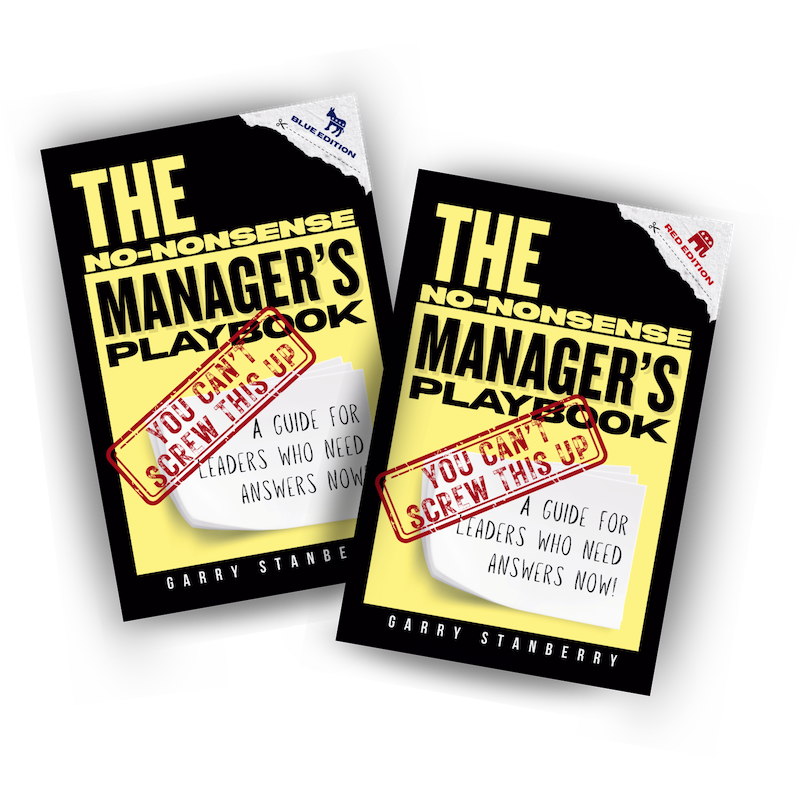
Download free chapter summaries
and a lot of other goodies!
Get free chapter summaries from the must-have playbook for managers. Whether you’re new to leadership or have years of experience, this book gives you real-world scenarios and exactly how to handle them. Written by a manager with over 45 years of experience, including 29 years as an Air Force officer, this is the guidance most managers never receive. If you want to become a more confident, effective manager, start here.
